GREENLAND: THE ISLAND THAT KEEPS SAYING NO TO EMPIRES
- Jack Oliver
- Feb 16
- 4 min read

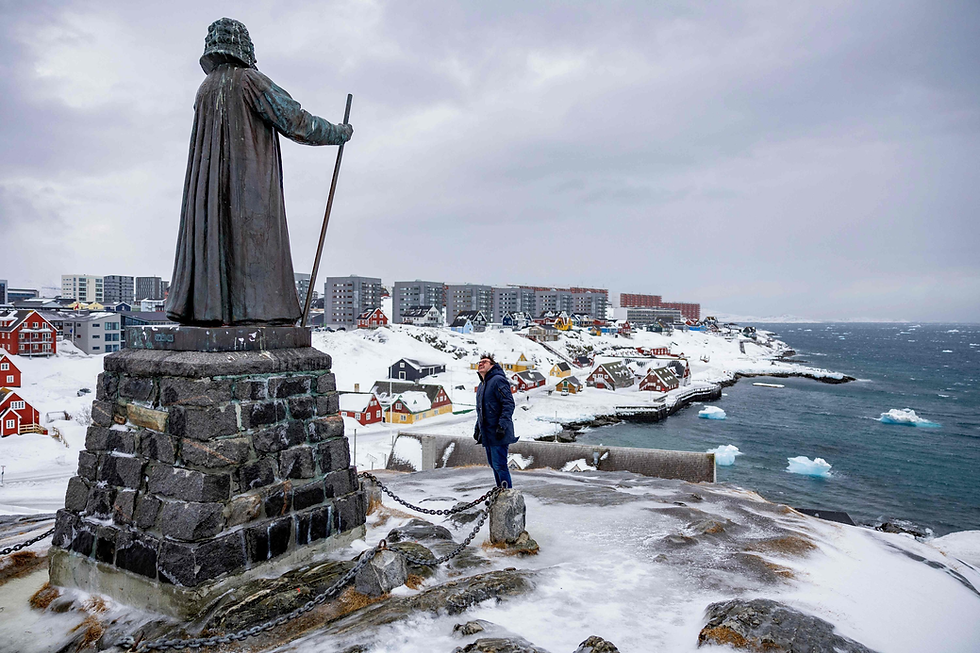
From Erik the Red to Mette Frederiksen, a millennium of polite defiance
From Erik the Red’s defiant exile in 982 AD to Mette Frederiksen’s steely “no” at the Munich Security Conference in February 2026, Greenland has spent more than a millennium politely but firmly rejecting outsiders who covet its icy expanse.
This vast Arctic island, larger than France, Germany and Spain combined, has outlasted Vikings, colonial powers, wartime occupiers and now a resurgent American interest under President Donald Trump’s second term.
The message from Nuuk to Copenhagen to Washington remains consistent:
“We will chart our own course, thank you.”
A THOUSAND YEARS OF SAYING NO
Greenland’s story of resistance begins in the late 10th century. Banished from Iceland for manslaughter, the Viking explorer Erik the Red sailed west in 982 AD and returned three years later with tales of a “Greenland” to lure settlers. Norse colonies flourished for centuries, but by the 15th century they had vanished, victims of climate change, isolation and perhaps Inuit resilience.
When Europeans returned in the 18th century, Denmark Norway claimed the island as a trading outpost.
The Treaty That Changed the Map
The pivotal shift came in 1814 with the Treaty of Kiel, which dissolved the Denmark Norway union amid the Napoleonic Wars. Sweden gained Norway, but Denmark retained Greenland, Iceland and the Faroe Islands as its North Atlantic dependencies.
For Greenlanders, then a mix of Inuit and dwindling Norse descendants, it marked the start of a new chapter under Copenhagen’s distant rule.
WAR, BASES AND A PERMANENT FOOTPRINT
The 20th century brought fresh suitors.
During World War II, as Nazi Germany eyed the island’s strategic position, the United States stepped in. Under a 1941 agreement with Denmark’s government in exile, American forces built or expanded 17 military bases across Greenland to secure supply lines and deter Axis threats. Troops numbered in the thousands. Airfields dotted the coast.
Most bases closed after 1945, but the United States never fully departed. Today, Pituffik Space Base remains a cornerstone of American Arctic defense, a legacy of that wartime bargain.
“The Second Colonization”
Postwar, Denmark tightened its grip. In 1953, it unilaterally incorporated Greenland as a county in the Danish realm. Many Inuit leaders still denounce the move as “the second colonization.”
The change stripped the island of its colonial label but offered little genuine self rule. Resource rights stayed in Copenhagen. Foreign policy and defense remained firmly Danish.
SELF RULE, BUT NOT FULL INDEPENDENCE
The turning point came in 2009 with the Act on Greenland Self Government. Copenhagen devolved control over resources, education and health, paving the way for potential independence.
Yet Denmark retained foreign affairs, defense and the annual block grant of roughly 630 million dollars, about 580 million euros today, that funds 60 percent of Greenland’s budget.
From Nuuk, the quiet refrain has been steady:“We will develop ourselves.”
THE PATTERN: PROTECTION AS PRETEXT
Every great power that has courted Greenland has offered a familiar bargain: security and prosperity in exchange for sovereignty.
And each time, the island’s 57,000 inhabitants, 90 percent Inuit, have responded with a courteous but unambiguous refusal.
The United States in the 1940s: “We will protect you from Nazis.” Bases arrived. They never fully left.
Denmark in 1953: “You are now part of us.” Many Greenlanders called it assimilation.
Trump in 2019: “Let’s make a deal.” The idea was dismissed as a real estate impulse.
Trump in 2026: A second term administration with leverage including tariffs, alliances and Arctic strategy has made the proposal feel more consequential.
Trump has framed Greenland as vital for countering Russia and China in the melting Arctic, citing minerals, shipping routes and missile defense. In January, he floated tariffs on Denmark and allies unless a “deal” materialized. At Davos, he claimed a “framework” with NATO Secretary General Mark Rutte. But in Munich this month, clarity replaced ambiguity.
“THE DESIRE IS EXACTLY THE SAME”
At the Munich Security Conference on February 14 and 15, 2026, Danish Prime Minister Mette Frederiksen and Greenland’s Premier Jens Frederik Nielsen delivered a blunt message.
Frederiksen said:“Everybody asks us, do we think it’s over? No, we don’t think it’s over. I think the desire from the U.S. president is exactly the same. He’s very serious about this.”
She called U.S. pressure “totally unacceptable,” stressing sovereignty as a “red line.”
Nielsen echoed the sentiment, describing the rhetoric as “unacceptable” for his people.
The two leaders met briefly with U.S. Secretary of State Marco Rubio and described the talks as “constructive.” Yet the subtext was unmistakable:Greenland is not for sale.
THE NUMBERS BEHIND THE NO
Polls underscore the resolve. Recent surveys show 76 to 85 percent of Greenlanders oppose joining the United States. Support for full independence from Denmark ranges between 56 and 84 percent depending on how the question is framed, but drops sharply if it means losing the Danish welfare model.
In a rare show of unity, all major Greenlandic parties declared:“We do not want to be Americans.”
The island’s leaders understand the financial reality. The annual Danish subsidy equals about 11,000 dollars per person. Replacing it with American funding would almost certainly come with conditions, including expanded military presence, deeper political influence and possibly eventual absorption.
HISTORY’S LESSON: FORCED UNIONS FAIL
The pattern stretches across centuries.
Empires promise protection and development. Greenlanders reply that they will accept the risks of self determination.
If Greenland votes for independence, as a constitutional commission is preparing for, the Danish subsidy would disappear overnight. The United States has deeper financial resources, but its Arctic track record centers on military infrastructure rather than equal partnerships.
Denmark, meanwhile, has evolved from colonizer to reluctant steward, funding a universal welfare system that Greenlanders value deeply.
THE FINAL WORD BELONGS TO NUUK
The most stable path forward lies in genuine equality. Greenlanders must decide their destiny, not in Washington boardrooms or Copenhagen ministries, but in Nuuk’s parliament.
The United States and Denmark can sit at the table as partners, expanding security cooperation, investing in critical minerals and respecting self rule. No landlords. No ultimatums.
In 1,044 years, Greenland has never said yes to empire.
In 2026, with the Arctic thawing and superpowers circling, the island’s polite “no” has never sounded louder or more necessary.


Comments